How fast the panic starts
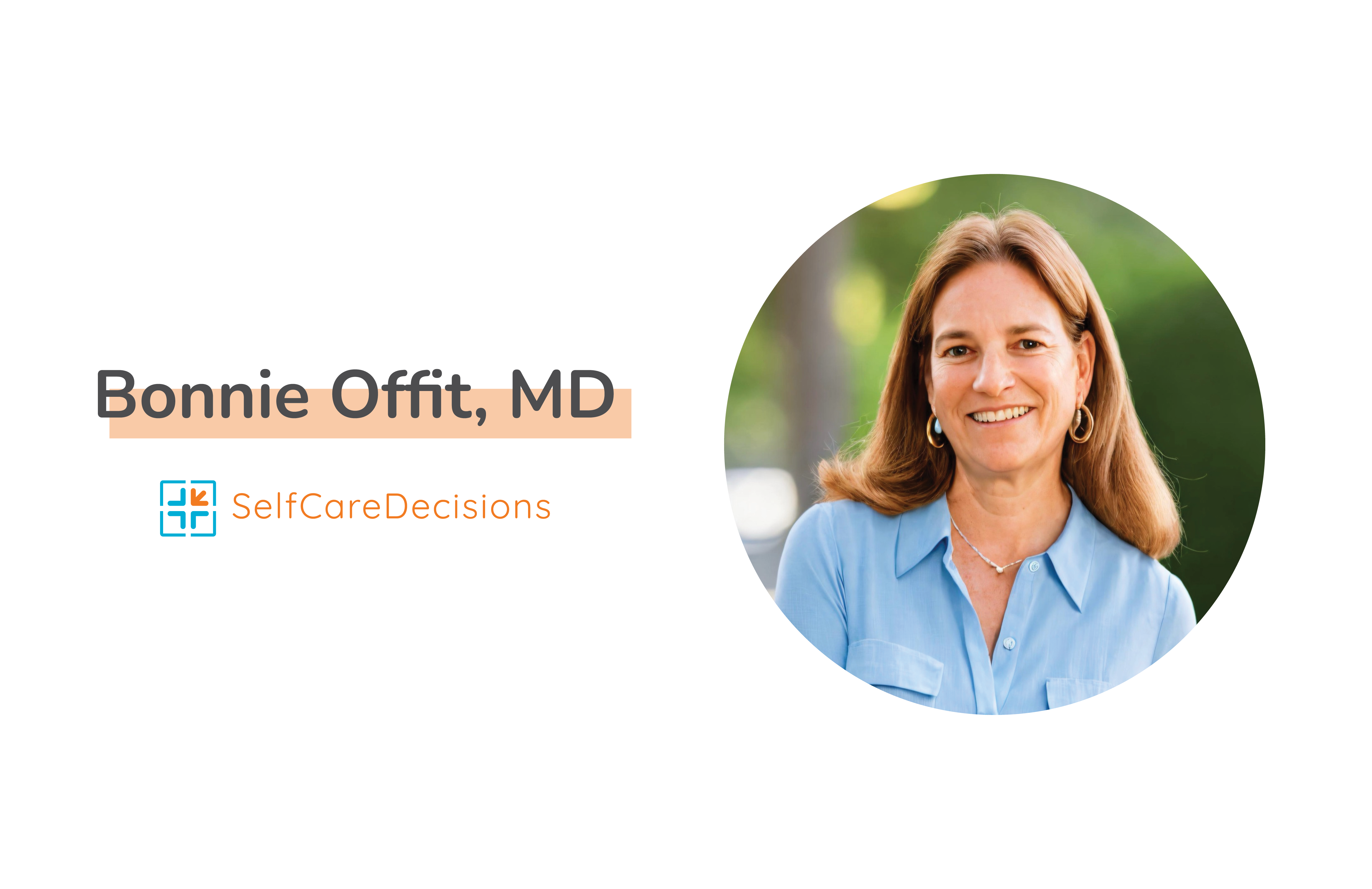
By Bonnie Offit, MD Chief Health Innovation Officer, Self Care Decisions
I'm winding down a long career in direct patient care, and lately I spend a lot of my time doing something I love: helping friends and family think through pediatric worries.
Here's what I've learned watching parents up close. A sick or injured child can take a parent from calm to full panic in about ninety seconds, and there's a reason that panic so often ends at an emergency room.
In my experience, roughly 95% of pediatric ED visits end in "treat and release," meaning the child is sent home. For adults it's closer to 80%. Most of those pediatric visits could have waited for daytime office hours, and most were low acuity to begin with.
Some of that is convenience. Emergency rooms are open at 2am when nothing else is. But a lot of it is fear, and from my experience, fear for your child's health and safety can start quickly.
A friend's six-year-old had a mild rash on her buttocks one evening. Two days earlier she'd spent a full day at the beach in a wet bathing suit. The rash was flat and red with a few dots at the border, not itchy, and not the least bit worrisome to me. I looked at the photos, asked a few questions, and suggested a cool washcloth and some over-the-counter antifungal cream.
When confident advice is the wrong advice
The next morning my phone rang. My friend and his daughter were already in the car, headed to the emergency room. She had woken with a stiff, painful neck and didn't want to move it at all. The night before, she'd had the mild rash, and he had typed his exact worry into a search bar:
"Could a rash last night and a sore neck this morning be connected?"
The AI answer was confident, and it was frightening. It told him yes, this could be meningitis, a medical emergency, and that a fading rash doesn't rule it out because the rash can change in the early stages. Get immediate medical attention.
Read that as a parent. Who among us wouldn't get in the car?
Here's what the answer left out, because it couldn't see the child. She had no fever, no vomiting, no other symptoms at all, and the rash had actually improved overnight. She was holding her head still because it hurt, but she was distractible, chatting, and in a good mood. She was not a sick-appearing child.
The likely cause was a neck muscle spasm called torticollis, probably from a pulled muscle or a little local inflammation, maybe even a nearby bug bite. Uncommon enough to be alarming, benign enough to watch at home.
Out of curiosity, I ran his exact question through several other AI tools. The answers were all variations on the same theme: cover the worst case, send them in. Even the most measured one still landed on "get this checked today, urgently."
That is the pattern worth noticing. Some tools are built to protect you from the rarest, worst possibility, so they optimize for coverage rather than calibration. And a frightened parent at 7am can't tell the difference.
What evidence-based triage does instead
The end of the story first. My friend's daughter's neck loosened up within the hour. No imaging, no blood draws, no long afternoon in a waiting room, no treatments she didn't need. Just a better day than the one he'd been bracing for.
So what would have really helped him at 7am, instead of a search bar?
Here's the part that matters for this story. With a triage tool based on evidence-based protocols such as Self Care Decisions' Care Triage Tool, his daughter's symptoms would have matched one of two care guides: localized rash, or neck pain and stiffness. Neither one would have sent him to the emergency room. Not because the tool is casual about meningitis, but because it asks the questions that actually separate an emergency from a benign case. Was there a fever? Was the child ill-appearing or listless? Were the spots purple? Was the rash severely painful to the touch? For his daughter, every answer was no.
He could have opened the home care guidance, read the background on the likely causes, and reached the same calm conclusion I gave him, at 7am, with no one else to call.
The difference isn't that one tool is careful and the other isn't. Both are trying to be careful. The difference is that a triage protocol is built to route a child to the right level of care, not to the scariest one.
As a pediatrician, here are a few things I'd leave with any parent:
- Be careful how much weight you give a search result or a chatbot, because they lean cautious by design and that caution carries real costs.
- Ask your question more than one way, since the framing quietly changes the answer you get back.
- Find out whether your hospital or your child's doctor offers a symptom checker on their portal, because if it's built on real triage protocols, it's a far better first stop than a search bar at 2am.
Bonnie Offit, MD
Self Care Decisions' self-triage tool is licensed to healthcare organizations and schools, built on the nurse triage protocols developed by Barton Schmitt, MD. Those protocols have guided more than 250 million symptom calls over 25 years, and the American Academy of Pediatrics has licensed our pediatric checker for HealthyChildren.org since 2010.
Other articles:
Looking for a smarter way to drive patient engagement? Our Symptom Checker acts as a clinical decision support tool that connects users to the right care at the right time. It integrates seamlessly with your scheduling, virtual visits, and in-person services, making it an ideal component of your digital front door strategy.